
Cast Iron Manufacturing Processes & Capabilities
Domestic Foundry Operations & Capacity
| Foundry Operations & Capacity | Technical Engineering Specifications |
|---|---|
|
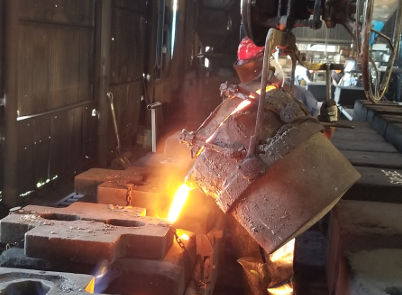
Wichita Falls, Texas Facility • Active Operation Since 1925 • Sourced #1 Cupola Cast Scrap • Squeeze / Anvil Jolt Pre-Compaction • Constant Transfer/Pouring Ladle Monitoring |
Melting & Production Infrastructure
• Cupola Furnace utilizing Maximum Achievable Control Technology (MACT)
• 2 Sand Mixing Mullers | 4 Molding Lines | 4 Pouring Bays • 2 Shot Blast Machines | 4 Grinding Lines • Finishes: Dip Station Painting, Spray Booth Coatings
Weight & Quality Capacity
• Production Casting Range: 1 lb. up to 2,000 lbs.
• Product conformity verified via calibrated precision instruments and gauges. |
OEM Supply Chain Logistics & Value-Added Engineering
| OEM Logistics & Infrastructure | Value-Added OEM Contract Engineering |
|---|---|
|
Supply Chain Systems • Dedicated On-Site Rail Spur • Direct Interstate Highway Access • Warehouse Safety Stock Available • Global Import / Export Management |
Engineering & Downstream Services
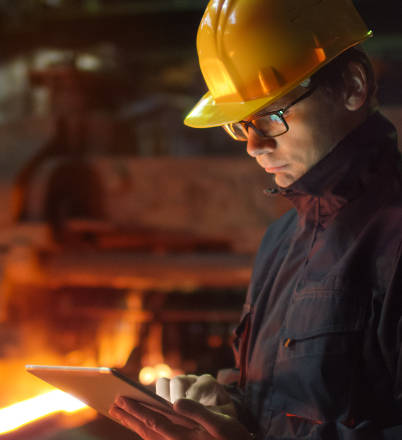
• Product Design Support: Component configuration and structural evaluation.
• Weldment Conversions: Redesigning multi-part assemblies into efficient single iron castings. • Machining & Fabricating: Ready-to-assemble finished industrial components. • Secondary Processing: Full Assembly work, Hardware Design, and Global Procurement. |
Alliance Foundries, Import & Global Sourcing Division
| Global Sourcing Division | Extended Metallurgical & Molding Processes |
|---|---|
|
Alliance Foundries Integration • Established Integration in 2018 • Verified Vetted Overseas Network • Broadens Scalability & Volume • Complete Multi-Destination Distribution |
Metallurgy Options
Gray Iron, Ductile Iron, Austempered Ductile Iron (ADI), Compacted Graphite Iron (CGI)
Advanced Sourcing Processes Available
• Molding Methods: Green Sand Casting, Dry Sand Casting, Resin Sand Casting, Floor Molding
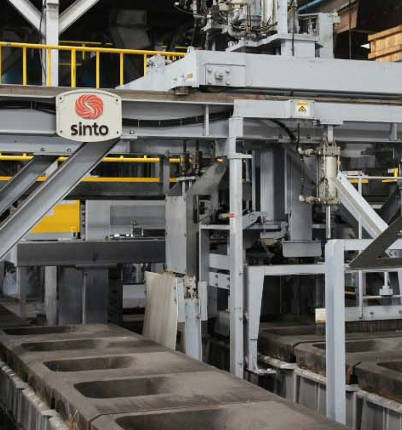
• Machinery Configurations: Sinto Flaskless High Pressure Molding, Disa Arpa Molding, BMM BT/CT Molding • Specialized Technology: V Process (Vacuum Molding), Cupola & Electric Melting Systems • Industrial Finishes: Dip Painting, Spray Painting, Commercial Powder Coating |
Decades of Manufacturing Experience & Quality Control
- Foundry Manager: Over 20 Years of Experience
- Melt Supervisor: Over 40 Years of Experience
- Technical Sales Team: Over 20 Years of Experience

Foundry Basics
Considering the knowledge and skill required to operate a cast iron foundry, most operators could, given the required time and investment, produce almost any cast iron part. The reality is that most foundries specialize in only a few product lines and processes. By specializing, they keep their production time and costs as low as possible and their quality as high as possible. Taylor Foundry Company, together with our own green sand foundry and global alliances, is able to provide the widest variety of products and cast iron manufacturing processes available.
SAND
The sand that is typically used to create casting molds is a silica sand (SiO2) mixed with various binders to maintain the shape of the mold. Sand is resistant to high temperatures allowing many different metals to be cast. Sand grains are very important and are specified by their size and shape.
Green Sand Molding
Uses a mixture of sand, water and a clay or binder.
Green Sand Molds are the least expensive and most widely used in the metal casting industry.
Skin Dried Molding
Starts much like a green sand mold but with additional binding materials.
The cavity surface is dried with a torch or other heating equipment to increase mold strength.
This improves the dimensional accuracy and surface finish but increases the chance of collapse.
Dry Skin Casting takes more time, decreasing production rates.
Dry Sand Molding
In a dry sand mold the sand can be green sand modified with additional binders or often sand mixed only with organic binders.
The mold is then strengthened by baking in an oven.
This type of mold has high dimensional accuracy but results in lower production rates.
No Bake Molding
The sand in a no bake mold is mixed with liquid resin.
The mold, due to the addition of the resin, will harden at room temperature.
Produces excellent surface finishes and can be used for very large castings.
The Cold Setting Process refers to any of several systems for binding molds or cores which relies on the use of catalysts rather than heat to harden.
The cold box process usually refers to a rapid core making process.
Hardening is achieved by chemical reaction rather than conventional baking.
A resin is added to the sand which reacts chemically when exposed to an accelerator, usually an organic gas, and hardens very quickly.
This reaction occurs at room temperature.
MOLD PACKING
There are many ways to pack the sand around a pattern, inside a flask, to create the mold cavity. Different methods will affect the dimensional accuracy as well as the surface finish. The sand can be packed by hand or with hand held pneumatic devices. A sand slinger fills the flask by propelling the sand at high pressure. A jolt/squeeze machine rapidly jolts the flask to distribute the sand and then uses pneumatic or hydraulic pressure to compress it. Vacuum molding packs the sand by removing the air between the flask and a thin sheet of plastic that covers the pattern.
Automated Flask-less Molding - In conventional molding a tight flask or pop-off flask is used for each individual mold produced. In Automated Flask-less Molding, a master flask is integrated into the mold producing unit with sand blown against the pattern inside. Once the mold is stripped from the mold producing unit, the two halves are held together with enough pressure to allow the pouring of the metal.